This Blog is about Cannabis, marijuana, weed, ganja.
Tuesday, 14 June 2016
Is Texas the next hotbed for growing cannabis for CBD?
Patrick
Moran, the founder and CEO of Texas Cannabis and its parent company
AcquiFlow, poses in the old cotton gin in the north Texas community of
Gunter on May 10, 2016. Moran plans to turn the building into a medical
marijuana facility. (William Luther, San Antonio Express-News via AP)
Businesses gear up for the Texas marijuana ‘green rush’ which is slated to boom in 2017.
By Peggy O'Hare,
GUNTER,
Texas — About 60 miles north of Dallas, amid green fields in the sleepy
town of Gunter — population 1,486 — Texas Cannabis CEO Patrick Moran
has optioned to buy a former cotton gin, where he plans to grow the
Cannabis sativa plant, known more commonly as marijuana.
The businessman and attorney is positioning himself at the forefront
of what he estimates will be a $900 million a year industry in Texas —
the recently legalized market for treating intractable epilepsy with a
strain of marijuana that eases seizures without getting patients high.
Texas, as it turns out, just may be one of the best states in the
nation to grow pot. While the state has one of the most stringent
medical usage laws in the country, it is setting up some of the cheapest
licensing fees and one of the least restrictive markets for pot growers
in the U.S.
Gov. Greg Abbott signed legislation last year allowing the state to
license businesses to grow, process or dispense non-intoxicating
marijuana or cannabis for medical use beginning next year. Moran wants
to do all three with Texas Cannabis, cultivating marijuana from seed to
sale.
Moran is just waiting on the state to set up its registry, slated to
go live by June 2017, to put in his application. He plans to use that
former cotton gin, which has sat dormant for 40 years, to cultivate,
extract and dispense cannabidiol oil, or CBD oil, from low-THC cannabis
plants — just around the corner from the city hall in Gunter. THC, or
tetrahydrocannabinol, is the psychoactive component that gives users a
high when they smoke traditional marijuana.
They are calling the new market the green rush.
“There’s a whole other industry that is being birthed in this
country, just like what happened with the dot-com boom,” Moran told the San Antonio Express-News. “I think it’s once in a lifetime.”
Texas is one of 18 states to approve laws since 2014 allowing some
form of CBD for patients with certain medical conditions. Under the
state’s new Compassionate Use Program, epilepsy patients whose seizures
can’t be controlled by traditional medication will be allowed to take
oil that is rich in CBD — a compound found in the marijuana plant
believed to have therapeutic benefits for some medical conditions.
An estimated 149,000 to 160,000 Texans of all ages
suffer from intractable epilepsy, which can be fatal. Around 40,000 of
those patients are projected to benefit from the medication, according
to the Texas Cannabis Industry Association.
The potential for rapid growth is tremendous, as more and more states
lift restrictions on marijuana use and sales and societal attitudes
toward the drug relax. Legal cannabis markets nationwide are projected
to yield $7.1 billion in sales in 2016, a 54 percent jump from $4.6
billion since 2014, according to a report released in February by
ArcView Market Research and New Frontier Data.
By 2020, legal sales nationally are projected to reach more than $22
billion, more than triple the amount forecast for this year, the report
states.
“No other industry in this country is making the kinds of gains
year-over-year that the cannabis industry is making,” said Dr. Scott
Bier, an emergency room physician in Houston who is CEO of Green Well
Ventures, another private company aiming to be among the state’s first
licensed cannabis operations. “And it’s just going to get bigger …
Everybody wants to get a little piece of it.”
Strict restrictions, but cheaper licensing
The Texas law established narrow parameters on the type of cannabis
that can be dispensed, who can take the medication and which physicians
can prescribe it, said Frank Snyder, a Texas A&M University School
of Law professor who teaches the state’s first course on marijuana law,
policy and business. But it doesn’t limit the number of competitors who
can grow, extract or dispense.
“The Texas law is the narrowest marijuana law in the country, in the
sense that it’s limited only to low-THC marijuana, and only for a very
narrow medical range — severe convulsions,” Snyder said.
“On the other
hand, the process for getting a license and beginning to cultivate is
probably the most liberal law of any of the medical marijuana states
that I’m familiar with right now, in terms of putting up the fewest
barriers to entry.”
Applicants aren’t required to have vast cannabis industry experience.
They simply have to show they have the technological ability to grow,
extract or dispense the product by having experience in related fields,
such as cultivation, analytical laboratory methods and handling
confidential patient information.
They also must show they can obtain the locations, resources and
personnel necessary for operations, maintain accountability of all
materials and have the financial ability to keep going for two years.
Regulations issued by the Texas Department of Public Safety in January also set fairly low licensing fees.
A cannabis operation seeking to become licensed in Texas must pay a
$6,000 application fee to the state. Businesses will have to renew those
licenses and pay another $6,000 application fee every two years.
That compares favorably with fees charged by some other states.
Massachusetts, for instance, requires a medical marijuana dispensary
to pay a $50,000 annual registration fee. Hawaii charges a $5,000
application fee, but requires a dispensary applicant to have at least $1
million in reserves, plus an additional $100,000 on hand for each
retail site. Florida requires an applicant seeking a cultivation license
to secure a $5 million performance bond.
Colorado, widely regarded as having some of the nation’s most
permissive marijuana laws, charges as much as $25,000 in upfront
application and licensing fees, depending on the type and volume of pot
sold, plus additional fees.
Texas has “no competitive business entry requirements. They’re not
going to weigh one person’s application against another in terms of
who’s more qualified to operate under a license,” Texas Cannabis
Industry Association Executive Director Kayla Brown said.
Moran hopes to sell Texas Cannabis products at his dispensary in
Gunter, other dispensaries across the state, and eventually, nationwide,
he said.
“We’re developing a brand,” Moran said. “The dispensary is the
cannabis equivalent of a CVS. I want to be supplying the aspirin to that
CVS.”
In the meantime, he’s been busy running AcquiFlow, which sells LED
lighting systems to industrial agricultural customers. AcquiFlow also
established an industrial-scale “grow” in Virginia, where its subsidiary
company, Living Farms, plants lettuce and basil and sells them to some
Whole Foods Market and Wegmans grocery stores.
Moran plans to replicate that growing operation in Texas, but will plant low-THC cannabis here instead.
AcquiFlow also has a partnership with two Kentucky companies licensed
to grow hemp under the Kentucky Department of Agriculture’s Industrial
Hemp Program. Moran said he’s developing hemp strains specifically for
the Texas market.
Established CBD businesses eye opportunity
Texas is drawing interest from out-of-state players as well. CW Botanicals,
a private company in Colorado that makes Charlotte’s Web Hemp Extract
products, is among those contemplating doing business here.
CEO Joel Stanley said “there’s a good chance” his company may work
with one of the licensed operations in Texas or perhaps jointly seek a
license with another business here.
“It would likely be a type of partnership in which we offer our
brand, our knowledge, our experience, our operating procedures, our
manufacturing practices and help that company set up,” Stanley said.
“We
are interested in finding the right group of like minds that will have
the financial wherewithal and business plan to provide this … until the
rules expand.”
Texas also is attractive because it will be some time before the
state becomes saturated like Colorado, said Bier, the Houston emergency
room physician who leads Green Well Ventures. He predicts Texas’ low-THC
cannabis industry could yield $100 million to $300 million a year in
revenue.
The company, which also plans to apply for a license early on, is
eyeing Houston as home base for its indoor growing facility and
production. It plans to open dispensaries in Houston and Austin,
employing up to 50 people once fully up and running.
Green Well’s dispensaries won’t just fill cannabis prescriptions, but
also will serve as traditional wellness stores, stocking products like
herbals, eastern medicine products and homeopathic products, and
possibly offering acupuncture or massages. “We may even open up before
our first (cannabis) harvest comes through since we have other revenue
streams,” Bier said.
State officials have created favorable conditions for businesses
seeking to enter the low-THC cannabis market, said Brown, of the Texas
Cannabis Industry Association.
“I think the bill passed so quietly that a lot of people don’t
realize Texas actually has the most permissive licensing structure in
the country,” she said. “You could not choose a better market to get
into.”
DPS is required to license at least three dispensaries by Sept. 1, 2017, providing applicants meet its requirements.
The agency is now soliciting proposals from contractors to build a
secure, online registry that physicians and licensed dispensaries can
use to provide the substance to patients. Once that registry is ready —
by June 2017 at the latest — growers, extractors and dispensaries can
begin applying for state licenses. DPS will conduct inspections to make
sure applicants comply with all regulations.
Tough rules for physician approval
The new state law forbids patients from smoking marijuana. They can
use it as an oil, resin, preparation, mixture, derivative or some other
compound derived from the Cannabis sativa plant. Patients with
prescriptions will be able to take it orally or apply it to their skin.
Prescriptions in Texas will require the approval of two physicians. A
“significant portion” of their clinical practices must be devoted to
evaluating and treating epilepsy, the law states. They also must be
board certified in epilepsy, neurology, neurophysiology, or neurology
with a special qualification in child neurology. Few physicians in the
state meet those requirements.
The Texas Medical Board could not provide any data showing how many
physicians in the state meet those qualifications. Cursory research by
the Texas Cannabis Industry Association indicates only 45 physicians
statewide fit the parameters of those who will be allowed to prescribe,
Brown said. Sindi Rosales, founder and CEO of the Epilepsy Foundation of
Central and South Texas, believes the number is even lower.
DPS regulations also set tight parameters for storing and transporting CBD oil, all raw materials and any byproducts.
“Even though this (CBD oil) has zero street value — you could drink a
gallon of this and never get high — I’ve got to have anti-diversion
protocols,” Moran said. “I’ve got to have 24-hour security. If it’s
transported in a vehicle, the vehicle has to have a safe inside.”
The rules assume a “worst-case scenario for those who oppose it or who have no faith in those who are in the industry,” he said.
DPS has indicated it will soon propose revising those regulations to
define more specific safety and security requirements, testing
procedures and waste disposal measures.
CW Botanicals, which already ships its Charlotte’s Web Hemp Extract
products nationwide, is keeping a close watch on the Texas market.
CEO Stanley hopes the state’s Compassionate Use Program eventually
becomes more inclusive.
“Ultimately, where it really starts to make
financial sense for any company is when they expand out of just
intractable epilepsy,” he said. Dr.
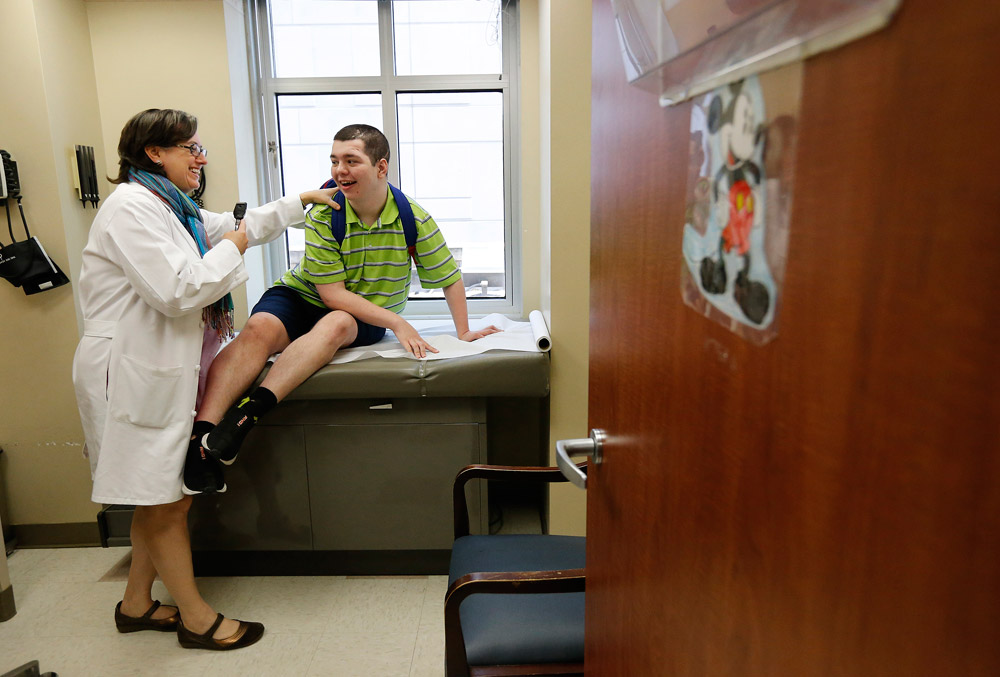
Gretchen Von Allmen, a pediatric neurologist, at Memorial Hermann and a
University of Texas Health Science Center Houston professor studying
epilepsy, visits with patient Travis Johnson in Houston on May 11, 2016.
Travis was diagnosed with a genetic form of epilepsy at 18 months and
has undergone numerous medical procedures including brain surgery to
help control his seizures. Von Allmen hopes she can prescribe CBD to her
patients in the near future. (Kin Man Hui, San Antonio Express-News via
AP)
At the University of Texas Health Science Center in Houston, Dr.
Gretchen Von Allmen, a pediatric neurologist specializing in epilepsy,
said patients’ families ask her “every day” how soon low-THC cannabis
will become available here.
“Most of them who are asking have already tried multiple
anticonvulsant medications that are available, and their children are
still having seizures,” said Von Allmen, who sees 50 to 100 epileptic
children a week at her practice. “These families are very desperate for
any other option.”
Some parents are giving their epileptic children CBD oil from
companies in other states, such as Charlotte’s Web, Von Allmen said.
“We need to make sure that it’s being used safely and that it’s not
affecting the child’s health otherwise,” said Von Allmen, chief of
pediatric epilepsy at the health science center’s McGovern Medical
School and director of the epilepsy monitoring unit at Children’s
Memorial Hermann Hospital in Houston.
“It will not be a cure-all for everybody”
Parents ordering CBD oil from companies in other states report
they’re typically paying a few hundred dollars a month for such
products, Von Allmen said.
CW Botanicals sells a 1-ounce bottle of Charlotte’s Web containing
500 milligrams of CBD for $52.49 through its website, while a 3.38-ounce
bottle containing 5,000 milligrams costs $275. The larger bottle
provides a six-week to two-month supply for a typical customer, Stanley
said.
“We deal with a lot of families who are out of time and out of
options. Knowing that we’re dealing with a very safe compound made from
hemp, the right thing for us to do is make it available and provide as
much information as we possibly can while the clinical research is being
done,” Stanley added.
The low-THC cannabis authorized by Texas law won’t be the answer for
all patients, predicts Dr. Freedom Perkins, a pediatric neurologist and
epileptologist at Dell Children’s Medical Center in Austin.
“I think for some people this is going to turn out to be a wonderful
thing … It will not be a cure-all for everybody,” Perkins said.
Gov. Abbott remains opposed to legalizing recreational use in the
state and has drawn a hard line at easing restrictions on traditional
marijuana, even for medical purposes.
Still, cannabis industry advocates plan to press the Texas
Legislature to add more medical conditions to the state’s Compassionate
Use Program during next year’s session.
And that would be very good for business.
“The great thing about Texas is, when it comes to the cannabis
industry, it’s an empty page,” Bier said. “There’s a lot of room, a lot
of population in this state, a lot of patients that can benefit from
this medicine. So I think the returns will be excellent once we’re able
to get a few more (medical conditions added) to the laws that already
exist.”
It won’t be difficult for licensed cannabis growers to accommodate
the extra demand once they build out their initial operations, Moran
said.
“You just turn up the volume … All you have to do is add acreage, add
labor and processing and put more product on the market to handle more
patients down the road.”




No comments:
Post a Comment