
A new state report shows that the total number of marijuana arrests in Colorado for juveniles increased after legalization — and racial disparities within those arrests grew worse.
Amanda Chicago Lewis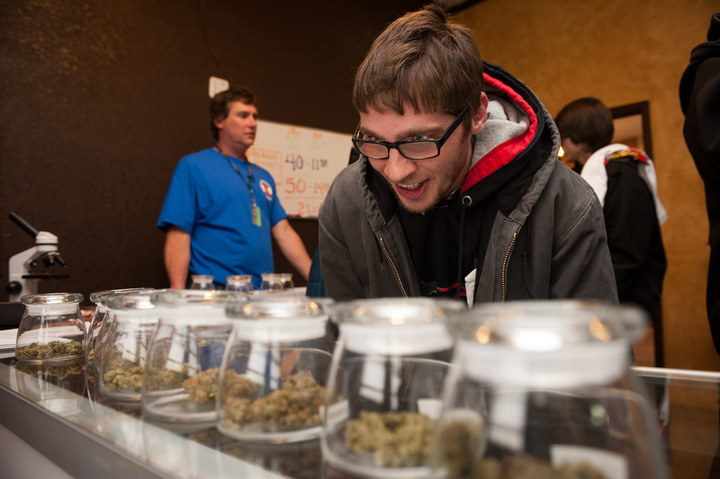
Tyler
Williams of Blanchester, Ohio, selects marijuana strains to purchase at
the 3-D Denver Discrete Dispensary on Jan. 1, 2014, the first day of
legal recreational sales. Theo Stroomer / Getty Images
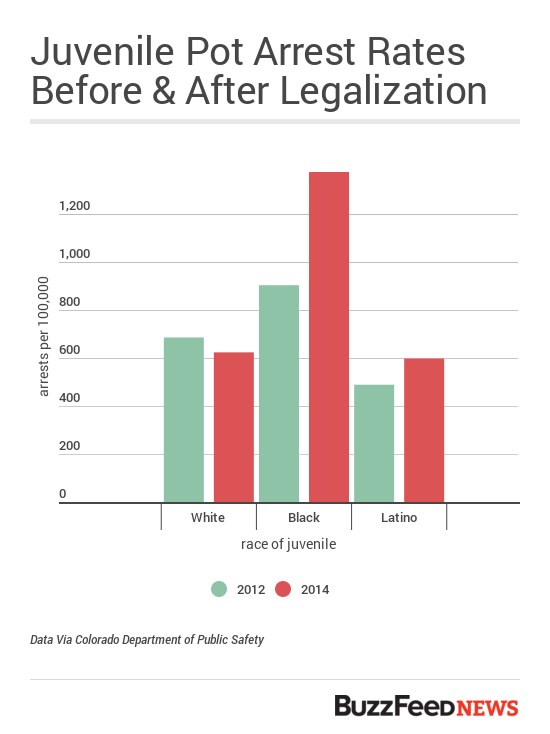
The report, released in March, found a striking racial disparity in how adolescents aged 10–17 are being arrested: White juvenile marijuana arrests decreased by 8% between 2012 and 2014, while black juvenile arrests increased by 58% and Latino juvenile arrests increased 29%.
Colorado voters passed an initiative legalizing recreational marijuana use in 2012 — the year is used in the report to represent pre-legalization. The first full year that the state’s 21-and-older recreational marijuana market was operational was 2014.
Between 2012 and 2014, Colorado elementary and secondary schools saw a 34% increase in marijuana arrests, the overwhelming majority of which were for possession. These arrests were often done by “school resource officers” — local police officers who have increasingly been stationed on campuses in recent years.
Although most of these juvenile arrests do not involve jail time, the student must pay a fine and, in order to get the arrest expunged from their permanent record, pay to participate in a drug education class.
The bulk of the juvenile arrests took place in 10 counties, each of which had over 100 marijuana arrests in 2014. The other roughly 50 counties typically had fewer than 25 arrests each.
The state report analyzed which schools, specifically, were suspending, expelling, and arresting the most adolescents for marijuana crimes: “The drug suspension rates are lowest in schools with a smaller proportion of minorities … Schools with the highest proportion of minorities have a drug suspension rate 110% higher than schools with the lowest proportion of minorities.”
According to a 2013 survey done by the Colorado Department of Public Health and Environment, Pueblo County has the highest rates of teen marijuana use in the state — 32.1% of high schoolers — but only five adolescents were arrested for marijuana-related crimes there in 2014. Compare that to Arapahoe County, which has about average rates of teen marijuana use (20.6% of high schoolers) when compared to the rest of the state (19.7%), but where nearly 400 students were arrested for marijuana in 2014.
Tustin Amole, the director of communications at Cherry Creek Schools in Arapahoe County, said that while her district decides how to handle marijuana offenses on a case-by-case basis, she felt the students who are being arrested accurately reflect which students are smoking pot.
“We don’t really have zero tolerance policies, because there are so many variations and circumstances. You have to take them all into account,” Amole told BuzzFeed News. “All I can say is while it may seem disproportionate, those are the students we’re catching with the drugs.”
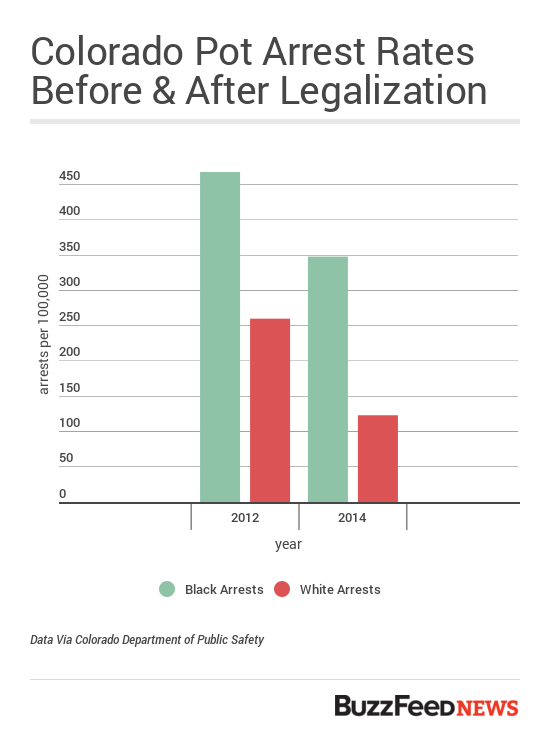
The state also found that while marijuana arrests among adults have nearly been cut in half since legalization, the racial disparities among those still being arrested grew slightly worse. In 2014, black people were arrested and cited for marijuana-related offenses at almost triple the rate of white people.
Back in 2012, black people in Colorado were being arrested for pot crimes at a little less than double the rate of whites.
Other states and cities that have decriminalized or legalized recreational marijuana use — including Massachusetts, Chicago, and Washington state — have seen a similar trend: a drop in overall arrests but persistent or increased racial disparities among those still being arrested.


No comments:
Post a Comment