Friday, 20 March 2020

Have heart problems? Harvard researchers caution against marijuana use

Harvard Health publishing


Smoking tobacco is a major cause of high blood pressure, heart disease, heart attack, and stroke. But did you know that smoking marijuana may also be associated with the same problems? A Harvard research review published Jan. 28, 2020, in the Journal of the American College of Cardiology found that more than two million U.S. adults with cardiovascular disease are smoking pot despite the risks, although they may not be aware of the potential link to heart problems. Studies on marijuana use have been limited, primarily because the substance has been illegal for decades. Scientists are calling for more research, since medical marijuana use is now legal in more than 30 states, and recreational use is legal in 11 states and the District of Columbia. "Until we have more answers about the connection between using marijuana and heart problems, you should consider avoiding smoking any form of pot if you have known heart disease or a high risk for a heart attack or stroke,"suggests Dr. Deepak L. Bhatt, a study author and editor in chief of the Harvard Heart Letter.

Thursday, 19 March 2020

Marijuana decriminalization bill has not altered UMW drug policies


by BERNADETTE D’AURIA
As of now, UMW intends to maintain its current drug policies, despite Virginia’s decriminalization of small amounts of marijuana earlier this month.
Decriminalization is not the same thing as legalization – the possession of marijuana is still unlawful. However, there are changes being made to the punishment prescribed by the state if found in possession of marijuana.
According to the bill that was passed, “It is unlawful for any person knowingly or intentionally to possess marijuana unless the substance was obtained directly from, or pursuant to, a valid prescription or order of a practitioner while acting in the course of his professional practice, or except as otherwise authorized by the Drug Control Act.”
This means that possession of the drug is still illegal in the state of Virginia. However, with this new bill, the penalty for possession has been lowered. Rather than facing jail time, those who are found up to one ounce of marijuana will face a Class 1 misdemeanor, with a penalty of $25.
Director of Student Conduct and Responsibility, Raymond Tuttle, said he does not anticipate any changes being made to the drug policies currently in place.
“However,” he says. “The policy is subject to review each year, and changes can be made in both behavioral expectations and sanctions as the need arises and philosophies change.”
Currently, the University’s drug policy prohibits the possession and being under the influence of any illegal drug. Violations of this policy result in students being charged with a violation of the Code of Conduct and possible criminal charges, depending on the offense.
Max Yarrow, head of UMW’s recently established chapter of the National Organization for the Reform of Marijuana Laws (NORML), anticipates the group working closely with Tuttle in the upcoming months regarding the campus’s drug policy.
NORML’s current mission is to change public opinion sufficiently to legalize the responsible use of marijuana by adults and to assume the role of an advocate for consumers to assure that the marijuana they are purchasing is safe, convenient and affordable.
Yarrow emphasized the particulars of the decriminalization law. Possession of refined cannabis products such as hash oils and edibles are still Class 5 felonies under this new legislation.
“I think that there will be a lot of people interpreting the civil penalty and decriminalization as being allowed to have open, public use, which is not the case. We do not have any consumption laws and if an officer sees you smoking you can get in trouble,” Yarrow said.
Moving forward with decriminalization, Yarrow says, “the school’s chapter goal going forward is to make sure the education about the decriminalization is clear, that it’s known that it isn’t legalization.”
He hopes to work with Tuttle and the University to move forward with the different sanctions than are currently in place regarding marijuana use or possession at the university. Yarrow argues that marijuana sanction policy should be “more focused on harm reduction for the students.”
This involves having a class that educates these students about the different ways one can be safe regarding the use of cannabis and not doing something that could potentially harm them down the line.
“It’s like drinking alcohol,” says Yarrow. “There are safe ways to drink that people have to be aware of if they want to be responsible. It’s the same with smoking.”

Monday, 16 March 2020

The NFL Will No Longer Suspend Players for Marijuana Use

Steve Bloom

Reader: Marijuana Users Should Stop Smoking During Virus Scare

Reader: Marijuana Users Should Stop Smoking During Virus ScareEXPAND
Flickr/Thom Chandler
Self-quarantines and sitting at home as events and public gatherings are canceled because of coronavirus concerns will lead many of us to break out the bong, but try to keep those smoking utensils to yourself, warns our resident Stoner.
"Start smoking out of your own devices and stop sharing mouthpieces with others — not just because of COVID-19, but because of germs and viruses that cause colds, flus and other sicknesses, too," Herbert Fuego shared in a recent Ask a Stoner column.
Mouthpieces are natural resting places for germs, and can still carry them even after being wiped down with alcohol — and the coronavirus is definitely on the minds of most cannabis users no matter how much they smoke.
But potheads can be at even further risk after smoking, according to one reader, a registered nurse. Says Claire:
They should stop smoking anything. Period. Maybe use edibles? Smokers have a much higher chance of becoming seriously ill with COVID19.
Peter Pryor, a doctor who owns Wheat Ridge medical marijuana practice Doc Morrison, agrees. He's been telling patients and friends alike to switch from smoking to edibles during the pandemic.  "Stop using your lungs for smoking marijuana. It's a lung injury, and that's what most people are worried about with this COVID-19 thing," he explains. "It's not the most important thing, but it can break down that barrier in your lungs, and that's what we're worried about right now."
Another reader looked at the issue from a different point of view, wondering what will happen to all of the shared joints at concerts and musical festivals.

Says Kris:
The coronavirus pandemic has affected the cannabis community in more ways than breaking up joint circles. Several cannabis and hemp trade shows have canceled or postponed their planned events this spring, and pot hospitality companies are banning shared smoking utensils while increasing sanitation and social distancing.

Friday, 13 March 2020

Busted marijuana grower says plant cured his colon cancer

By Bangkok Post

THAILAND: A man caught growing about 1,000 marijuana plants in a large greenhouse told police they were for medical use and he had cured his colon cancer by eating and drinking the leaves.

Montri Thiwavornchai, 53, centre, is arrested when police raid his marijuana nursery in Kham Thale So district of Nakhon Ratchasima last night (Mar 12). Photo: Prasit Tangprasert
Officers from Provincial Police Region 3 raided his house in Nong Sruang village in Kham Thale So district last night (Mar 12).
They found a large nursery, 12 metres wide and 36 metres long, in the grounds. There were 976 marijuana plants planted in rows of pots.
Montri Thiwavornchai, 53, a local builder, told police he had invested about one million baht in constructing the nursery to grow organic marijuana in a closed system. He bought seeds from a neighbouring country for B3,000 a kilogramme.
He had planted them about three months ago and planned to harvest the plants in about two months.
Mr Montri said he had suffered from colon cancer, which was in the third stage in 2014. He used marijuana to treat his cancer, by boiling the leaves to drink. He also ate fresh marijuana leaves. He said his cancer had been cured.
So he then invested in marijuana farming. He intended to grow these plants for medical use and distribution to local residents with illnesses.
He had not yet sought permission to grow the plants because of the bureaucratic red tape.
Police initially pressed two counts against him – illegally growing marijuana and possessing a Type 5 narcotic.

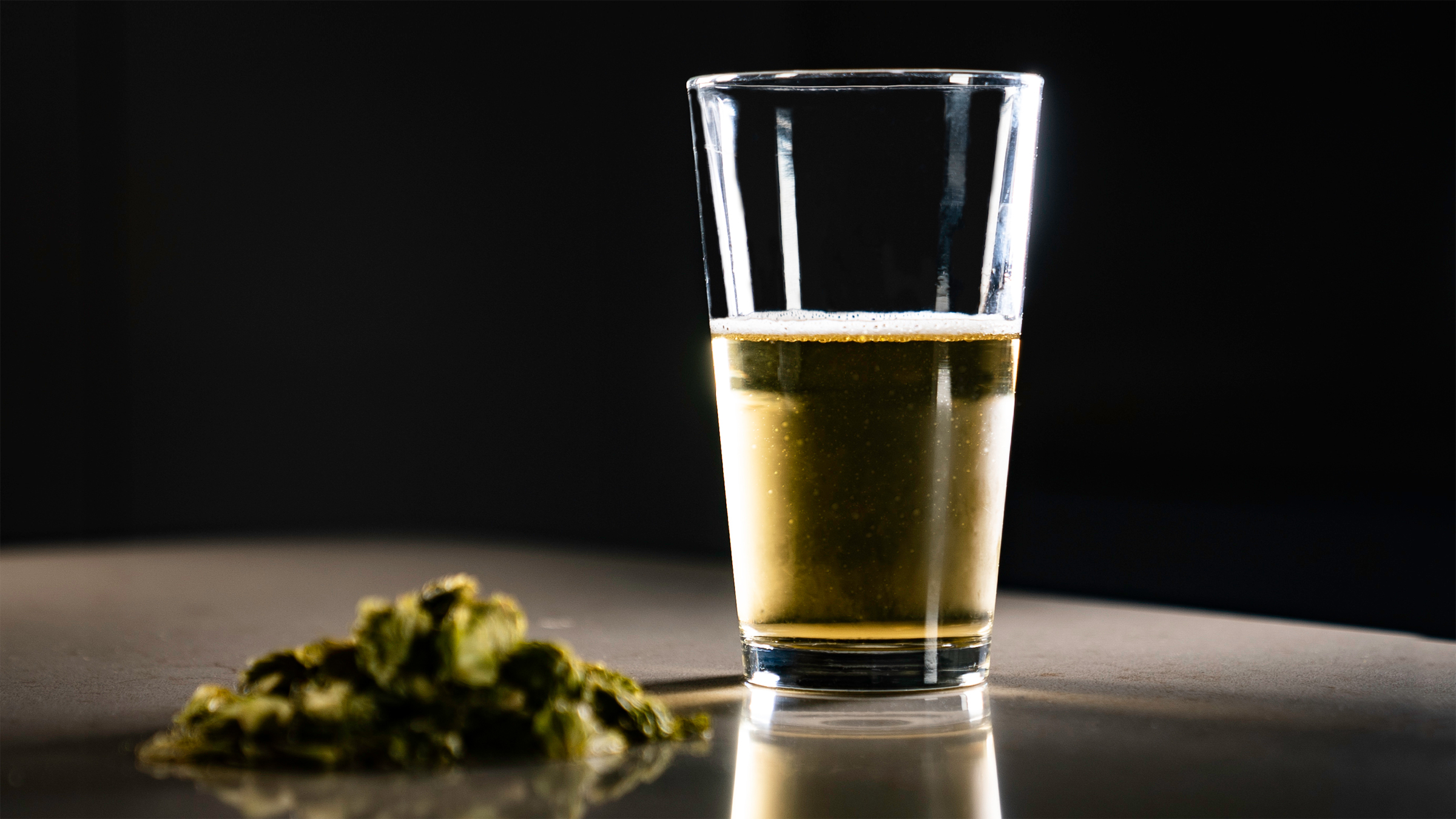
What happens when you mix cannabis and alcohol?

Can consuming cannabis and alcohol together change your reaction to both? (Getty Images)
By Dan Webster

It’s only natural to take a soothing drink after imbibing a bit of cannabis. Especially when such imbibing involves some kind of smoke.
And let’s be honest – nothing cools off a palate better than a cold beer, a chilled glass of wine or some other iced alcoholic drink.
Yet this poses a question: What effect, either short or long term, does mixing cannabis with alcohol have on your body?
From a pure physiological stance, it’s difficult to say. Since we’re still in a situation where the U.S. government considers marijuana a Schedule 1 drug – thus partnering it with heroin, LSD and ecstasy and rating it more dangerous than cocaine, meth or oxycodone – federal funds devoted to researching the effects of cannabis haven’t been exactly flowing.
Yet some research, however limited, has been conducted. And a number of those studies have proven inconclusive, sometimes even contradictory.
According Healthline, an online health resource, one 2010 study showed that mixing alcohol and cannabis had little effect. Then again, a 2015 study – which involved participants consuming alcohol (or a placebo) before being asked “to inhale either a low or a high dose of THC” – indicated that those who drank alcohol showed “significantly higher peak THC levels.”
Yet both studies were fairly small – the 2015 participants numbered just 19 – so the conclusions are debatable.
A 2019 study by Penn State University is more definitive. Recruiting some 1,017 participants from 49 states between the ages 18 and 25, the study compared people who drink alcohol to those who drink alcohol and use marijuana simultaneously.
“The results suggest that individuals who simultaneously use alcohol and marijuana are at a disproportionately higher risk for heavy, frequent and problematic substance use,” said Ashley Linden-Carmichael, an assistant research professor at Penn State’s Edna Bennett Pierce Prevention Research Center.
“The problem with simultaneous use is that it can affect people cognitively and perceptually, and also have an impact on motor impairment,” Linden-Carmichael In a 2014 Psychology Today article, Constance Scharff, Ph.D., made the case that mixing alcohol and cannabis can pose a specific potential harm. 
She pointed out that the human body has a natural reaction to the overconsumption of alcohol: vomiting.Yet citing a Northwestern University study, Scharff wrote that “marijuana has an antiemetic effect, meaning that it makes it more difficult for the body to vomit.” This, she added, can lead to a possibly lethal condition: alcohol.
Offering its own set of guidelines, the Centers for Disease Control and Prevention (CDC) flatly states the following: “Using alcohol and marijuana at the same time is likely to result in greater impairment than when using either one alone.”
The CDC adds that anyone taking prescription drugs should check with their physicians to make sure any kind of marijuana and/or alcohol use will affect their prescribed medications.
Maybe the best advice comes from a researcher named Scott Lukas, a professor of psychiatry and pharmacology at Harvard Medical School.
Talking to Vice.com, Lukas explained one of the difficulties involved in researching the effects of combining alcohol and cannabis: “Not everyone responds to alcohol and marijuana the same (way),” he said.
Lukas’s advice: Use common sense.
Be judicious, he said, don’t overdo and “always err on the side of caution.”

'We're going to practice our sovereign rights': Oglala Sioux Tribe enters new era with cannabis vote


Welcome to Oglala Lakota Nation. Photo by Jimmy Emerson

The Oglala Sioux Tribe approved referendum measures Tuesday allowing the use of marijuana on the Pine Ridge Reservation for both medical and recreational purposes, but tribal citizens rejected a measure that would have allowed the tribe to sell alcohol in the reservation’s two casinos.
Unofficial vote totals showed tribal citizens struck down the alcohol measure with 885 voting for it and 1,428 voting against it. Voters approved the medical marijuana measure with 1,840 voting for it and 412 voting against it, and they approved the recreational marijuana measure with 1,585 voting for it and 576 voting against it, according to the preliminary results.
Ricky Gray Grass, fifth member of the tribe’s executive committee, said the tribe must now begin drafting regulations to establish a taxing system for marijuana sales. He said the tribe doesn’t plan to grow or sell marijuana itself but will allow individual tribal citizens to do so. The tribe is concerned that getting into the marijuana business would risk the loss of federal funds.
“We’re going to practice our sovereign rights under the treaties,” Gray Grass said in an interview. “Being a sovereign nation we have the rights to govern ourselves and have our own laws.”
In 2015, the Flandreau Santee Sioux Tribe of South Dakota abandoned its plans to open a cannabis resort and burned its crop fearing the tribe’s marijuana operation would be raided by federal agents.
Gray Grass said he is hopeful the Oglala Sioux Tribe can work with federal and state officials to ensure his tribe’s citizens aren’t penalized for growing and selling marijuana. Medical and recreational use of marijuana isn’t currently legal in South Dakota.
He said the tribe is examining the regulations enacted by the Las Vegas Paiute Tribe, which legalized marijuana growing and sales and opened two marijuana dispensaries. He said the tribe is also examining the state of Colorado’s marijuana regulatory system, which includes a 19.2 percent tax on marijuana sales.
“It’s going to take time to work on the laws,” Gray Grass said.

He said at least a dozen individual tribal citizens have expressed interest in growing marijuana and two others said they want to open marijuana dispensaries. The tribe doesn’t plan to allow large marijuana distributors to sell marijuana on the reservation.
He said the tribe conducted listening sessions and even hosted a two-day cannabis conference about two weeks ago to educate people about how marijuana sales would be regulated.
He said he is happy tribal citizens agreed that the benefits of marijuana outweighed the possible negatives of allowing marijuana sales.
“I was excited for the people that went out and voted,” he said. “I think this is the biggest turnout in any election.”

In August 2013, the Oglala Sioux citizens voted by a margin of 52 to 48 percent to legalize alcohol at Pine Ridge, one of the last dry reservations in the country. The ordinance was never enacted because tribal officials charged with implementing it but who opposed legalization failed to enact it.
Bryan Brewer, who was the tribe’s president at that time, said he opposed alcohol legalization then and remains opposed to it. He said the 2013 referendum was handled poorly and only about half of the reservation’s voting precincts had open polling sites.
“A lot of the people did not get to vote,” Brewer said in an interview. “This (election) was run right, and the people got out to vote.”
“I’m really happy with it. I really am.”
He said he supported legalization of marijuana use, saying marijuana sales and taxation could provide significant revenue for the tribe and for individual tribal citizens.
“That could be a big economic boost for the tribe if we can do it and the tribe does it right,” he said. “Maybe the people could make a little money.”