Tuesday, 4 September 2018

Medical Marijuana Curbs Local Woman's MS

by Connor Gerbrandt
 
Joanne Gauthier-Wiebe with some medical cannabis drops

“Cannabis has given me my life back,” says Joanne Gauthier-Wiebe, a La Broquerie resident who notes medical marijuana has done wonders in curbing the symptoms of her secondary progressive multiple sclerosis.

Gauthier-Wiebe says the debilitating disease initially prevented her from reading, remembering, walking properly, and even led to her quitting her teaching job prematurely. “Once you get secondary progressive its kind of a steady decline,” she informs, “and yet in the last five years, since I have started taking cannabis, my health has significantly improved.”

After realizing the dramatic effects the drug can have when taken properly Gauthier-Wiebe says she became an advocate for marijuana’s many redemptive qualities. “You can be pain-free and not be stoned. You start taking cannabis and all of the sudden you realize you can take a few drops and ‘Oh my gosh now I can function and go throughout my day!’”

Gauthier-Wiebe recognizes a lack of information in the area and has begun organizing classes that discuss cannabis as a medicine. She says such events have already taken place in Beausejour, Niverville, and La Broquerie. The next class is slated in Steinbach sometime early fall where Gauthier-Wiebe says a lot of people who use prescription marijuana will share their stories.

“We’re afraid of the unknown and people need to realize how much it can help them,” indicates Gauthier-Wiebe, “The reason we started having these meetings is because people were in pain, they’d go to see their doctor, they’d get a permit and not know what to do with it.”

Though the concept of medical marijuana is entirely separate from its recreational legalization this coming October, Gauthier-Wiebe comments on the impending plebiscite. She feels elderly people whose health is improved by the drug will gain obvious benefits from a local dispensary, adding those who abuse it will likely do so whether or not it is legal.

Gauthier-Wiebe thinks people need to be more informed and suggests her story is one of many that speaks towards the positive influence cannabis can have given certain circumstances.

Mothers Who Smoke Weed May Pass in on Through Their Breast Milk

Marijuana compounds can stay active in breast milk up to a week after mothers smoked it, scientists warn.

Monday, 3 September 2018

The Surprising Neurological Effects Of Combining Cannabis And Tobacco

By Calvin Hughes

The use of cannabis and tobacco often reduce the neuro-connectivity in the brains of people who consume one or the other separately. However, this is not the case with people who consume both.

Both cannabis and tobacco effect the brain in different ways. And while there is an established body of research evaluating exactly what these effects are, very few studies have looked at what happens in the brain form people who smoke both substances. And that has created a big gap in our understanding of these substances, according to Dr. Francesca M. Filbey, who hopes to fill that gap with her recent research.

"Most of the literature to date has focused on associations of isolated cannabis and nicotine use, even though concurrent cannabis and nicotine use is more prevalent in society than cannabis use alone," Filbey - the Bert Moore Chair in BrainHealth at UT Dallas - said in a statement. "Our findings confirm the limitations of existing research."

Using MRI scans Filbey examined the neuro-activity of people in four groups. The first was comprised of tobacco consumers, the second of marijuana consumers, the third of people who use both substances and a control group that did not consume either. The scans showed that the control group had the greatest connectivity in most scenarios, while the only-cannabis and only-tobacco groups showed less (though to varying degrees). The group of people who consumed both cannabis and tobacco had results that were most similar to the control group with higher neuro-connectivity than either of the one substances groups.

These findings seem to suggests that tobacco and cannabis may counteract some of the effects of each other in the brain, though more research is needed to solidify that conclusion. Nevertheless, Fibley hypothesizes that developing a greater understanding of the interactions between these two substances will be useful in developing programs for people who are looking to quit.

Retail cannabis is newest money-maker on the reservation

Tulalip Remedy is the first pot shop on tribal land in Snohomish County and the sixth in the state.

by Andrea Brown

Workers greet customers at the door with computer tablets to assist and take orders.

Three front-row parking spots are designated for “Elders only.”

Tulalip Remedy is not a typical pot shop.

The flagship store is owned by the Tulalip Tribes, a sovereign nation with its own governing body and laws. Out of 497 licensed cannabis stores in the state, this is only the sixth to open on tribal land.

The emporium is an oasis in the parking lot at Quil Ceda Village in the former KeyBank building.

Sleek and modern, it boasts glass display cases like a jewelry store. An artsy Pacific Northwest mural encircles the room.

“Oh, man. It’s impressive,” said Randy Ervin, a Tulalip resident who came for sativa concentrate at the opening Aug. 9. At his feet was his little service dog, Jaxx, who stayed mellow among the noisy crush of shoppers.


The Tulalip Tribes waited four years after recreational weed stores opened in Washington to partake in the retail action. The tribes and the state have a compact, a negotiated agreement that spells out the mutual guidelines for dispensing the drug.

The tribes also are funding research at a Stanford University lab in California to study the medicinal attributes of marijuana.

There are 51 cannabis retailers in Snohomish County. Before, Tulalip members had to leave the reservation to get a remedy to toke or vape to heighten their wellness or soothe their ailments.

That meant traveling to Everett, Arlington or Lake Stevens. Marysville banned sales within city limits.
This is no mom-and-pop head shop with bars on the windows.

It’s a high-tech fortress. The tribes invested in the latest technology for merchandising. There are 62 cameras, with plans to add more. The windows are stylishly boarded with polished wood as a design accent.
Crystal Puckett looks over the cannabis products at Tulalip Remedy. (Kevin Clark / The Herald)

Inside is a weed wonderland. The store sells tinctures, rubs and edibles. Indica, sativa and hybrid strains of flower. Pipes, bongs and vaporizers. Budtenders explain the ABCs of THC and CBD with user-friendly graphics and charts.

The expansive Quil Ceda Village is popular grounds for locals to shop and maybe shoot craps. There’s a Walmart, Cabela’s, The Home Depot, Seattle Premium Outlets and the Tulalip Resort Casino.

It’s a gambling-dining-shopping destination.

More than half of the hundreds of thousands of tourists are Canadian, said Les Parks, an elected member of the Tulalip Tribes Board of Directors.

Les Parks (Kevin Clark / The Herald)

Which brings up the red leaf, which was designed to represent gathering around a fire, not be a beacon for the northern neighbors.

“When they see that, they are thinking maple leaf. ‘Here’s a Canadian restaurant. Let’s get something to eat,’” Parks said.

“They come in and find out what it is and they walk out the door giggling.”

No wacky tabacky needed.

1-2-3 … Grow
Cannabis on the reservation was once a pipe dream for Parks, a longtime tribal leader.

He was the driving force for the tribes to get into the market.

Not all members were in favor.

“They said this tribe will never get into the marijuana business,” Parks said. “It has been a four-year journey.”

Ramie Faust (left) is checked out by Jeni Birmingham at Tulalip Remedy. (Kevin Clark / The Herald)

Washington has 29 tribes who are not bound by state restrictions, and in 2015 the first tribal pot compact was signed by the Suquamish. The Puyallup Tribe has both a pot testing lab and a store.

In July, the Muckelshoots opened Joint Rivers in Auburn with the first drive-thru window at a cannabis shop in the state.

Remedy plans to add window service. The former bank building has the bones for it.

You won’t find those on Highway 99.

“State licensees cannot have drive-up windows. They are not allowed under law,” said Mikhail Carpenter, Washington State Liquor and Cannabis Board spokesman. “But they are not expressly prohibited under compacts.”

Revenues have blossomed since recreational cannabis shops opened in 2014 in Washington, two years after voters passed Initiative 502, which legalized the sale, consumption and taxation of recreational marijuana products.

The drug is illegal under federal law, but tribes in Washington haven’t had any issues despite the Trump administration’s rescinding Obama-era guidance that had recognized tribal sovereignty over pot.

“In the first full year of legalization it generated $64 million in excise tax,” Carpenter said. “In the last fiscal year completed it was $357 million.”

Wiyanna Benally demonstrates the tablets used by staffers at Tulalip Remedy. (Kevin Clark / The Herald)
A 37 percent excise tax is levied on the sale from retailer to consumer — in addition to sales tax.
Tribal stores are required to tax the same percentage as what others stores pay to the state. That amount is retained by the tribes instead of going to city and state coffers.

The Tulalips have earmarked its use.

“A percentage of the profits is going to addiction and problems on the reservation,” such as homelessness and mental health, Parks said.

There are nearly 5,000 members of the tribes, of which about half live on the 22,000-acre reservation north of Everett and west of Marysville.

Customer service
Nick Roman came from Lake Stevens for “some flower.”

He’s already a repeat customer and Remedy rewards member.

“It’s good product. Good service, too,” he said. “It’s more of a Starbucks setup. Order. Get it. Leave.”

Cynthia Leon-Ortiz popped in for oil-based cannabis potions.
Robert Monger performs with Teri Gobin at the preview opening of Tulalip Remedy on Aug. 9. (Kevin Clark / The Herald)

“It helps me sleep,” she said. “If I have daily activities that are strenuous it helps me with my body aches. It gets me through the day. When I take pills it is more harsh on my body.”

It was her third time at Tulalip Remedy.

“This place doesn’t judge you,” the Tulalip resident said. “This is my new go-to.”

Business has been steady at Tulalip Remedy, but not yet the green rush the tribes anticipates to come.

On a recent weekday mid-afternoon, employees far outnumbered shoppers.

Many of Tulalip Remedy’s 62 employees are tribal members. All underwent extensive training.

Service is personal and concierge style, using the Apple store model of sorts.

“We’ve taken the traditional budtender away from the counter and put them out on the retail floor.

We’ve given them hand-held units so they have an opportunity to walk up to each person and engage them where they are in their cannabis journey,” said Jonathan Teeters, assistant manager.

“Whether you’re a first-time customer or never used cannabis or you’re a pro.”

Workers wear uniform shirts color-coded to denote their positions, like the “Star Trek” crew.

Budtenders wear red and carry tablets that explain the menu of products. Behind the counter, cashiers in green ring up orders. Managers don black shirts.

After paying with cash, customers get a ticket number for orders, which are quickly filled in the back, then placed in a small, protected window behind the counter. Shoppers can also order ahead online and their order will be ready when they arrive.

There’s a Remedy rewards program for specials and discounts. Sign up and get a text for 10 percent off.

Radio-frequency identification tags, known as RFID, are put on every item to track sales. Unlike a barcode, which is also used, the postage stamp-sized tag doesn’t have to be within sight of the reader.

Macy’s also uses RFID.

“It allows the tribes to be assured that we have 100 percent control of our inventory at all times,” said Doug Boon, store manager. “It gives us more consumer intelligence for patrons who come here and allows us to build better points of sale for them.”

In another move, the Tulalips Tribes established its own regulatory body, the Tribal Cannabis Agency, to monitor itself.

“No other tribe has that,” Carpenter said. “They are the first ones.”

T’yana Green watches as Juan Martinez hands a purchase to a customer. (Kevin Clark / The Herald)

The cure
Parks dispels the old stereotypes of reefer madness.

“Our customers are not ‘Cheech and Chong,’” he said. “The old theory that cannabis is the gateway to addiction is outdated. That’s Nixon theory.”

Marijuana was placed as a Schedule I, the most dangerous group of controlled substances, under Richard Nixon’s watch.

The majority of people who use marijuana do not go on to use “harder” substances, according to the National Institute of Drug Abuse.

Instead, it could possibly offer the cure for more serious addictions, such as opioids.

The tribes are sponsoring research at the Barron Lab by Stanford bioengineering professor Annelise Barron, director of the California campus site.

“This is exciting because it is still difficult to obtain federal funding to study for the benefits of cannabis,” said Barron, who got her undergraduate degree in 1990 at the University of Washington and also earned post-doctoral degrees elsewhere. “Specifically, we’re doing a rat study to determine the efficacy of cannabinoids to treat opioid addictions.”

Another research project is its use for Alzheimer’s disease.

Already, CBD, a non-psychoactive cannabinoid isolated from the cannabis plant, is in products targeted for issues such as pain and insomnia. CBDs don’t contain the THC that gets users high.
But that euphoria is why many shop here.

Parks expects Tulalip Remedy to reap a bundle.

“Twenty million a year in sales is not out of the question,” he said. “If you’re earning $20 million in revenues, that’s $10 million in profit.”

Still, pot has nothing on gaming.

“By gaming standards it’s not a big revenue-producing impact to tribes, but it is an impact. And every little impact is a positive to each tribe’s membership,” Parks said.

Tulalip Remedy is managed and overseen by the Tulalip Economic Development Corporation. The store is just the start for the new tribal organization geared toward business.

Vertical integration is the buzzword here.

In Washington, there are three separate license tiers: producer, processor and retailer. State law prohibits people from doing all three.

But state law does not govern sovereign nations like the Tulalip Tribes.

“We can do all three. Our compact allows it,” Parks said.

He envisions a grow operation, a testing lab and a processing facility to supply this store and possibly more to come.

“We are going to get there. It’s not a question of if, it’s when.”

A silent movement for the legalisation of cannabis is spreading across India

The Great Legalisation Movement has two agendas: quietly provide cannabis oil to cancer patients, and press the government to lift the ban on using marijuana.

NYPD change in marijuana arrest policy goes into effect


Police will put a stop to arresting people for smoking marijuana in public.

This means that the city expects about 10,000 fewer arrests

Officials said the policy was implemented because most of these arrests have nothing to do with public safety.

It is also intended to level the playing field. Studies show that white people smoke marijuana at the same rates as other demographics, however, the vast majority of arrests take place in communities of color.

"Our new policy, we're going to see a humongous drop in people in communities of color being arrested for marijuana," NYPD Chief Rodney Harrison said. "And that was one of the whole goals of this whole new policy."

Officers will be able to decide whether or not to arrest people caught smoking marijuana in public.

In some cases, arrests will be made. Anyone caught driving while smoking and anyone refusing to show identification when requested by an officer and anyone with an outstanding warrant will be arrested.

Why the Trump Administration's Plot to Derail Marijuana Momentum Will Flop Bigly

Marijuana stock investors shouldn't worry about the federal government's secret plans to whack weed before it grows too much support.

Keith Speights 
 
On Wednesday, online news site BuzzFeed reported that the Trump Administration is engaged in a "secret war on weed." BuzzFeed stated that the Marijuana Policy Coordination Committee told multiple federal agencies to submit "data demonstrating the most significant negative trends" about marijuana use. The goal appears to be to try to prevent further support for relaxing federal anti-marijuana laws.

If the committee is successful in its efforts, companies with U.S. marijuana operations such as Scotts Miracle-Gro (NYSE:SMG), CannaRoyalty (NASDAQOTH:CNNRF), and Kush Bottles (NASDAQOTH:KSHB) could see their hopes of operating in a fully legal environment dashed.
But don't go shorting these stocks. Here are three reasons why this plot to derail marijuana momentum will flop -- and do so bigly.

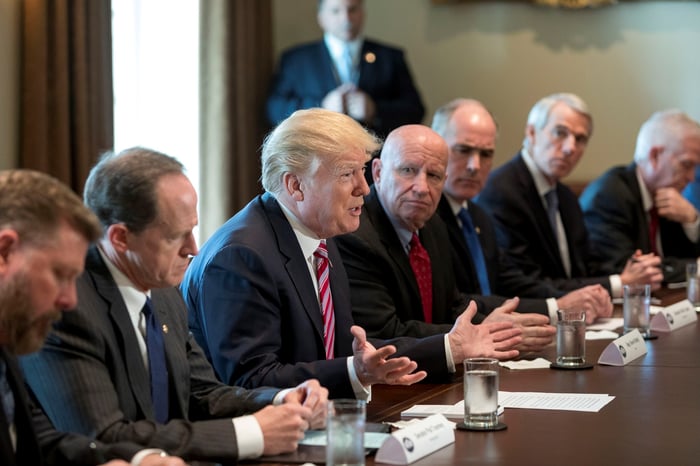
President Trump in meeting with his advisors.
Image source: WhiteHouse.gov. 

1. It's not coming from Trump

Love him or hate him, one thing pretty much everyone will agree on about President Trump is that he marches to his own beat. He stated in his presidential campaign that his top adviser was himself. So far, that statement appears to be pretty accurate.

The effort to cast marijuana in a negative light isn't coming from Trump. Instead, it's being coordinated by the Office of National Drug Control Policy (ONDCP). Jim Carroll is the head of the ONDCP, a position also known as the "drug czar." Carroll isn't a close confidante of the president. He wasn't even Trump's first pick for the position.

President Trump has publicly expressed his view that states should be allowed to make and enforce their own marijuana laws. In April, he pledged to support legislative efforts led by Sen. Cory Gardner (R-Colo.) that would prevent federal interference in states that have legalized marijuana (like Gardner's home state of Colorado). The Denver Post reported that Sen. Gardner's spokesman stated that the senator "remains confident in the commitment the president made to him to support a states' rights solution to the current disconnect on marijuana law." 

2. It's a bad political move

Coming out swinging against efforts by states to legalize marijuana is a bad political move on multiple fronts. First, President Trump would be blatantly going against what he has publicly stated he supports. I know, what a shock it would be for a political figure to do a 180. But Trump would catch a lot of flak -- and he knows he would.

Speaking of flak, a major reason why the president came out in favor of relaxing federal marijuana laws earlier this year was that Sen. Gardner was holding up confirmations of political appointees. If Trump breaks his word, you can bet that Gardner will resume the logjam that worked pretty effectively in the past.

It's no secret that the American public has grown increasingly supportive of the legalization of marijuana. I doubt that a report from a group called the Marijuana Policy Coordination Committee based on data collected from more than a dozen federal agencies is going to sway public opinion. Quite honestly, the committee itself sounds like a creature from the swamp in D.C. that Trump has promised to drain.

3. The cat's out of the bag already

The nail in the coffin for the "secret" effort to derail the momentum for marijuana is that it's not a secret anymore. The cat's out of the bag already thanks to the reporting by BuzzFeed. And because it appears that the committee's report will be intentionally biased, I suspect that it will be largely discredited from day one.

More important, though, the cat's out of the bag already with respect to legalized marijuana in general. Thirty states plus the District of Columbia allow legalized medical marijuana. Nine states allow the legal use of recreational marijuana. More are likely to follow in their footsteps.

The U.S. Food and Drug Administration (FDA) even recently approved a marijuana-based drug for treating rare forms of epilepsy. That would make it hard for the committee's report to convincingly argue that there aren't medical benefits associated with marijuana.