
New Jersey marijuana arrests
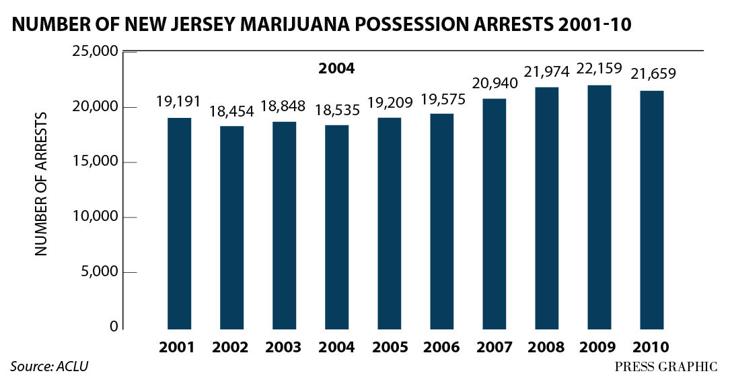
increased 10 percent during 2012 and 2013, according to the latest State
Police Uniform Crime Reports. There were 24,765 arrests in 2013, nearly
double the number of arrests in 1993, according to the UCR and an
analysis by the state American Civil Liberties Union. The state spent
more than $127 million enforcing possession laws in 2010.
 Roseanne Scotti, state director
of the New Jersey Drug Policy Alliance, said the recently released
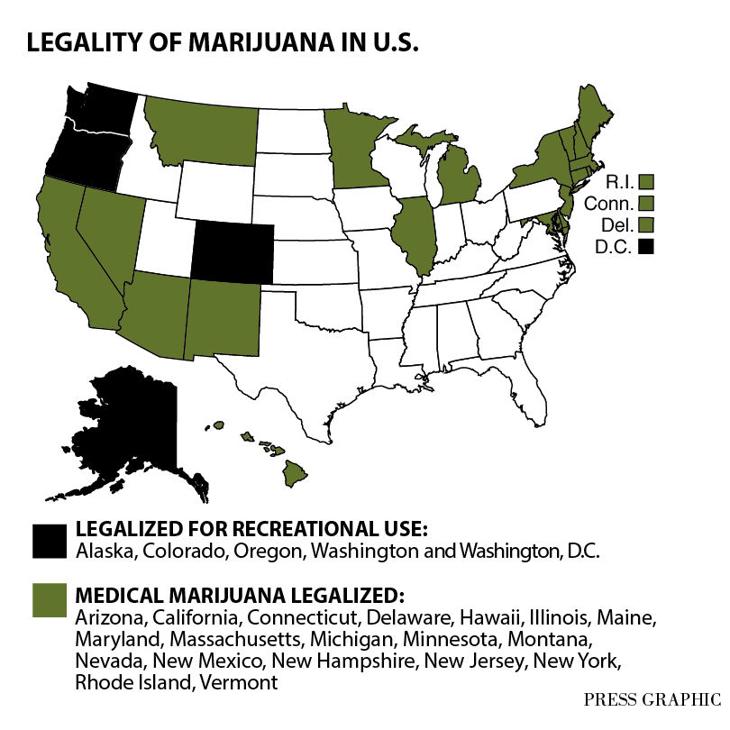
numbers are appalling because the state is close to legalizing the drug.
Roseanne Scotti, state director
of the New Jersey Drug Policy Alliance, said the recently released
numbers are appalling because the state is close to legalizing the drug.
“That’s 24,000 people whose lives
are ruined because of small amounts of marijuana. I believe it will be
legal in two years here in New Jersey,” she said.
 Proposals have been made to
decriminalize marijuana possession in New Jersey, but Gov. Chris
Christie, who would have to sign off on any such legislation, is an
outspoken opponent.
Proposals have been made to
decriminalize marijuana possession in New Jersey, but Gov. Chris
Christie, who would have to sign off on any such legislation, is an
outspoken opponent.
State Police figures show that
marijuana accounts for 57 percent of all drug-possession arrests in the
state, more than all other drug possession and sales arrests combined.
Those arrests disproportionately affect people of color.
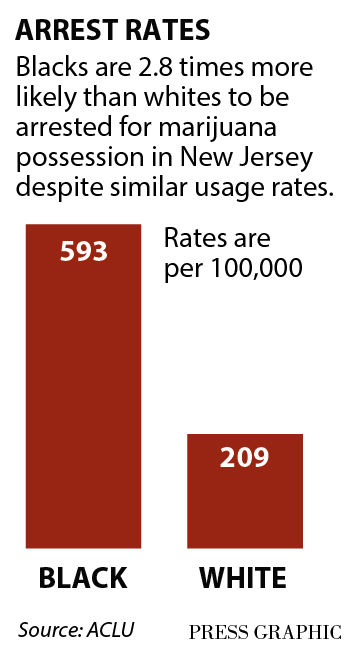
The ACLU says that despite
similar usage rates, black people are 2.8 times more likely than white
people to be arrested for marijuana possession. In Ocean County, black
people were 4.8 times more likely than white people to be arrested for
possession.
On Nov. 16, state Sen. Nick
Scutari, D-Middlesex, Somerset, Union, led a hearing on the idea of
legalizing marijuana. Scutari has introduced legislation to tax and
regulate marijuana, treating it like alcohol.
“The meeting was to discuss
legalizing marijuana to create a billion-dollar industry, create jobs,
create tax revenue and rid our streets of crime and illegal drug
dealers,” Scutari said. In states that have legalized marijuana, “there
have essentially been no downsides,” he said. “It’s changed their entire
unemployment structure (in Colorado).”
In 2014, Philadelphia
decriminalized the possession of small amounts of marijuana.
Marijuana-related arrests there dropped 73 percent over the first six
months of 2015, according to a philly.com report.
Across the river in New Jersey,
possession of 50 grams or less of marijuana carries a penalty of as many
as six months imprisonment and more than $1,000 in fines for a
first-time offender.
The state’s 21 county prosecutors
sent a letter in April to state Senate President Stephen Sweeney and
Assembly Speaker Vincent Preito, stating “unanimous opposition” to bills
that would legalize small amounts of marijuana for those over age 21.
“The long-term impact on
marijuana use includes negative effect on IQ and learning, lower job
productivity and performance and the economic and social costs to
society for treatment,” the letter read.
The prosecutors said legalization would exacerbate the state’s budget issues, rather than solve them.
Atlantic City resident Will
Vertus, 26, agrees. “I think it shouldn’t be legal, because drugs, they
cause a lot of problems,” he said.
Avalon resident Ryan Ellis said
the focus on marijuana arrests is counterproductive. “There are other
things that need to be addressed,” he said. “All it does now is hurt
low-income families if a family member gets arrested.”
Bill Caruso, an attorney and
former executive director of the state Assembly Majority Office and a
member of the steering committee of the New Jersey United for Marijuana
Reform coalition, said a rough estimate of revenue and savings from
legalization is several hundreds of millions of dollars.
In the first fiscal year after
Colorado legalized marijuana, the state brought in more than $70 million
in taxes, more than the $42 million it got for alcohol taxes, he said,
and New Jersey has double the population of Colorado.
“It’s not a question of ‘if’ anymore. It’s a question of ‘when’ and ‘how,’” Caruso said.


No comments:
Post a Comment